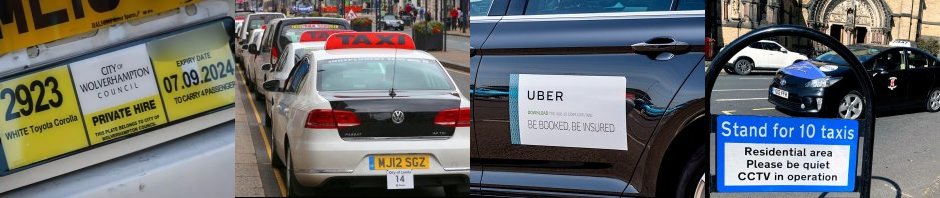
There’s potentially quite a lot of material relating to Wolverhampton City Council’s decision to ban operator livery signage on its 30,000-strong fleet of private hire vehicles working the length and breadth of England. Therefore maybe best to concentrate primarily on the council’s news release on the issue, which made the point, referring to the Government’s best practice guidance, that:
Government also believes that high levels of signage can draw attention to private hire vehicles and leads the public to mistake them for taxis. People then approach them for immediate hire, which is unlicensed, uninsured and illegal for the driver.
Who knew that the likes of liveries, third-party advertising and rooflights might lead the public to believe that a PHV was a taxi available for immediate hire, and thus facilitate illegality by unscrupulous drivers?
To that extent banning liveries can hardly be disputed. On the other hand, following the ban a major operator in the West Midlands complained that customers would thus have difficulties identifying vehicles they had booked, therefore with potential safety implications. This argument also seems valid. However, Wolverhampton, while echoing the best practice guidance, also broaches the issue of ‘fake taxis’, and the extent to which fake signage can be used to deceive those seeking to secure a genuine vehicle:
This aims to prevent impersonation of private hire vehicles by anyone who prints their own imitation signage and operates as an illegal taxi.
There have been incidents reported nationally of fake signs being used on unlicensed vehicles to impersonate genuine ones. In some serious cases, unlicensed drivers have attacked lone passengers.
Wolverhampton further posits the following alternative to door signs for legitimate identification purposes:
The change, which has been approved by the council’s regulatory committee, is designed to ensure that passengers focus on the private hire vehicle licence plate on the rear of the vehicle to verify their booking.
Much of this seems a tad naive, however, and more based in theory than reality. It would be interesting to analyse the issue scientifically, but it seems to me that the worst of the safety-related incidents (sexual attacks, most obviously) are the result of either legitimate hires on the one hand, or on the other by fake drivers who in no substantive way attempt to disguise their vehicle by way of mocked up signage or similar. Unfortunately, the vast majority of victims in such circumstances seem to be intoxicated to a significant degree, in which case the absence or otherwise of signage is probably not the most problematic factor.
A related issue is that in the high-risk late-night drunken ‘reveller’ environment, the chances of normalising the checking of rear licence plates by the most vulnerable passengers seems remote. Moreover, when demand is high in the early hours, and vehicle availability is limited, a degree of passenger recklessness in securing a car is more evident, fuelled by alcohol and/or drugs, and in such circumstances revellers may not be too bothered if drivers are in breach of the licensing rules, irrespective of the view that licensing officers and councillors might take if such breaches were actually detected.
So it’s at least arguable that, while binning door liveries and signage would make it more difficult for PHVs to illegally ply for hire, it would do nothing to deter and prevent more serious incidents, and indeed could facilitate such happenings – if licensed PHVs are largely unmarked, then clearly it’s easier for fake drivers to impersonate a legitimate vehicle.
Moreover, it’s a bit rich of Wolverhampton to claim the moral high ground regarding signage and identification issues when its vehicles are operating in perhaps 100+ different local authority areas. Thus even if plate identification was to become the norm, this would be complicated by the prevalence of Wolverhampton and other cross-border plates in particular areas, along with locally-plated vehicles. And with different authorities continuing with different signage requirements, this could result in an inconsistent mishmash of plates and signage on cars working in a particular town’s or city’s high-risk nighttime economy environment.
Indeed, this is ably illustrated by Wolverhampton’s press release on the subject of the alternative to booking a PHV, namely securing a hackney carriage plying for hire at a rank or in the streets generally:
People who need a vehicle immediately, should look for hackney carriages (black cabs) with an illuminated ‘TAXI’ light, which indicates that they are available for hire.
Problem is, this advice is clearly referring to the Wolverhampton City Council area, because it seems almost certain that in dozens of the areas in which Wolverhampton PHVs are working, the hackney carriages won’t be ‘black cabs’ (by which is presumably meant London-style cabs, in simple terms). Instead, they’ll be standard saloon, hatchback and estate cars, thus just like the Wolverhampton PHVs.
Which in turn underlines another point in the Government’s best practice guidance, which Wolverhampton is strangely (but predictably) silent on:
To assist the differentiation [between hackney carriages and private hire vehicles] further, licensing authorities which require taxis [hackney carriages] to be a particular colour should prevent private hire vehicles from being that same colour…
And which clearly couldn’t work universally, because Wolverhampton Council can’t specify the colour of hackney carriage in the 100+ licensing authorities in which its PHVs are operating…
Thus to the extent that both the Government’s guidance on PHV signage and Wolverhampton’s implementation thereof is efficacious, it’s totally undermined by the latter’s status as England’s cross-border ‘taxi’ capital. And which both parties conveniently ignore.
Lastly, as regards the confusion that all concerned seem to hope to alleviate, the fundamentally different terminological approaches of both parties here are worth noting – the Government’s best practice guidance uses the taxi/private hire dichotomy (the norm for central government and bodies like the Law Commission, the Competition and Markets Authority, and HMRC). Meanwhile, Wolverhampton Council follows the more standard local authority practice of using the t-word generically, and the two codes are referred to as hackney carriage and private hire.
And all that said, Wolverhampton’s holier-than-thou attitude to proscribing door livery signage is surely holed below the waterline by the following exemption in its new HC/PHV licensing policy document (which again echoes the Government’s guidance):
Where an exclusive relationship exists between the vehicle proprietor, driver and operator, operator signage may be displayed on the vehicle. The expected format of this is sticker branding (no larger than A4 in size) on the rear of the vehicle. Magnetic signage will not be approved. Signage must be approved by Licensing Services before it is displayed.
Come again? It seems that Wolverhampton licences over 400 different operators, with their 30,000 or so vehicles working in probably 100+ council areas. All but a handful of those operators (Uber and Bolt, most obviously) are highly likely to insist on such an exclusive relationship, so to that extent the signage ban will probably amount to little more than reduction in sticker size for the vast majority of operators.
A video of the Wolverhampton licensing committee meeting endorsing the signage change contains several jaw-dropping moments, but at one point the licensing manager seemed to be saying that an exclusive relationship between operator and driver would entail a ‘contract of employment’ and thus confer worker’s rights. Which perhaps underlines why the slightly bizarre exemption from the signage ban seems strangely absent from the council’s spiel on the issue – the suggestion that the vast majority of private hire operators licensed by Wolverhampton Council deal with their drivers under contracts of employment is simply ridiculous. Their drivers will be almost wholly self-employed or freelancers, and only Uber and a handful of operators will regard the employment status of drivers as ‘workers’, and even this falls short of a contract of employment, or employee status.
(Perhaps Wolverhampton Council is so used to dealing with and being bedazzled by the Uber behemoth that they’ve lost touch with the reality of the legacy trade which will comprise the vast majority of private hire operators they licence, which in turn maybe explains their emphasis on driver and vehicle information supplied via smartphone apps as another facet of identification which means door signage can be dispensed with.)
Meanwhile, back in the rest of the non-Wolverhampton licensing world, the BBC reports that Sheffield City Council has refused to compromise its PHV signage requirements despite requests from drivers who think they might be targetted following the recent riots and disorder. The council’s policy reads:
Door signage affixed to the rear doors must be the design of the licensing authority, be securely fixed and contain the name of the operator(s) along with contact information – phone number or app details.
By the same token, in Darlington, where Uber has just been granted a private hire operator’s licence and will thus add locally-plated cars to those already working there under licences granted by several other different authorities, it’s reported that:
The [licensing committee] meeting heard how some Uber cars are more identifiable than others because of the amount of clear signage due to differing conditions within each local authority.
Or no signage at all, presumably, if any Wolverhampton-licensed cars roll up in Darlington.
But clearly the reach of the Government’s best practice guidance isn’t all-encompassing. Yet.
In the meantime, drunken revellers rolling out of nightclubs at 4am will presumably be comparing door signage size and details, and will be carefully noting that if their Wolverhampton-licensed driver has an exclusive relationship with an operator then a rear door sign smaller than A4 size will be present (or may be present, more precisely), while no such exclusive relationship means they’ll have to inspect the rear plate instead. That is, assuming they even know which local authority has licensed the car they’ve booked…