
One of the most contentious issues in the UK taxi and private hire trades in recent years has been card payments (which also includes the likes of smartphone payment apps, contactless etc – it’s therefore all about automated payments instead of cash, essentially, which don’t require an ongoing account with a taxi firm, or similar).
Of course, as per consumer-facing businesses generally, the ‘taxi’ industry has largely progressed to accepting card payments, a process accelerated by lockdown, and partly driven by the totally automated booking and payment systems pioneered by app-based providers like Uber and Bolt.
However, a residue of taxi drivers have refused to come into line, which has caused resentment from taxi users, and conflict between drivers. Of course, just like in any other business sector, to an extent the cash-only dinosaurs are all very well, because in a market economy it’s still up to businesses and their customers to decide whether they want to continue using cash-only, or automated payments only, or, as per probably most retail and similar businesses, a mix of the two, depending on customer preference.
So to that degree the customer is king, and indeed probably the vast majority of taxi and private hire despatch businesses now offer an alternative to cash payments, at least as an option. However, as regards taxis hired at ranks or hailed in the streets, the normal rules of competition don’t work so well, because the method of engagement is essentially random, and thus ‘market failure’ exists.
There’s still a degree of competition along with the element of market failure, though, because passengers who can only pay by card will simply select another taxi (although obviously in times of short supply that may prove difficult, and in any case undermines the convenience of hiring a vehicle on the streets). Or they will stop using the ranks altogether for the same reasons, and instead pre-book a provider offering automated payment facilities.
But to the extent that there is an element of market failure, in many jurisdictions taxi regulators have made the provision of non-cash payment alternatives compulsory. For example, Transport for London, which licenses the UK capital’s ‘iconic’ black cabs, says this:
All licensed taxis must be fitted with a TfL approved card payment device installed in the passenger compartment which has the facility to produce a printed receipt upon request by the passenger.[…]
Any taxi found not complying with the requirement will be issued with an unfit notice…[…]
Unfortunately, outside the capital England has something like 300 different local authorities licensing taxis, and it’s up to each whether or not to make the likes of the above rule compulsory in their own area. Some have, and some haven’t, and this process can be long and convoluted, with reviews, surveys, consultations, committee meetings, recommendations, more consultations, and perhaps a requirement for full council approval rather than decision by official fiat or by specialist licensing councillors. Blah, blah.
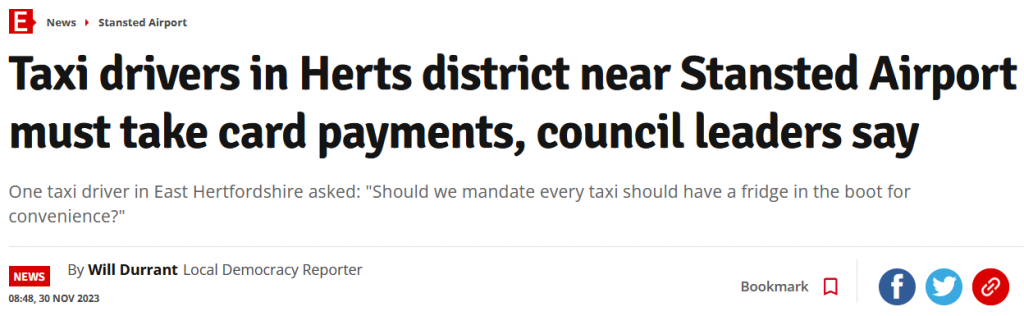
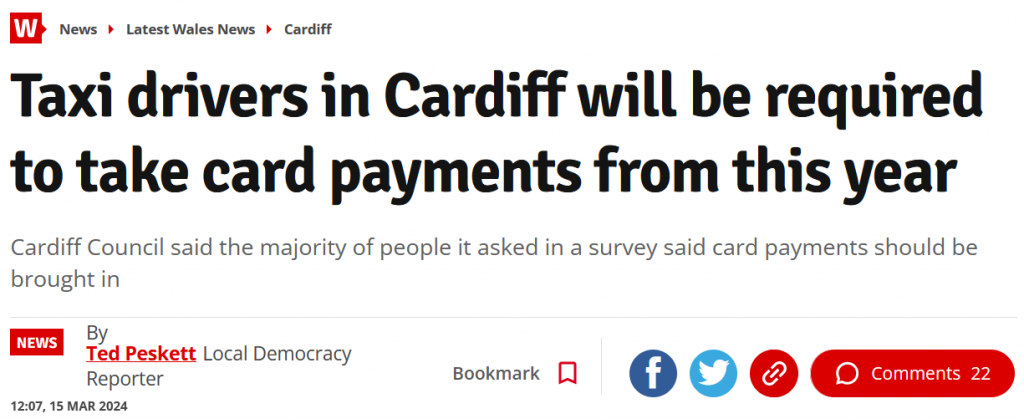
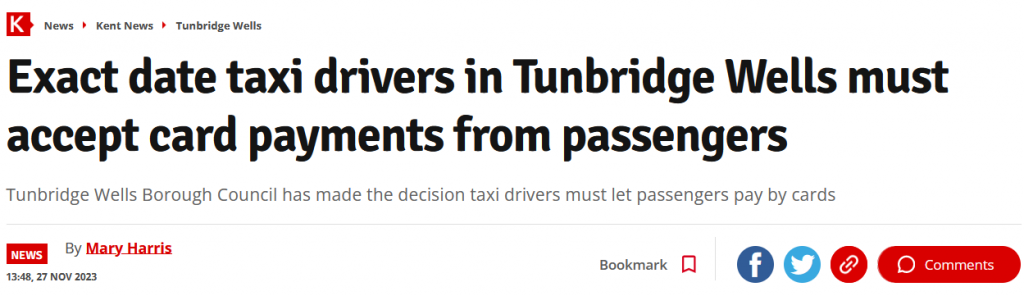
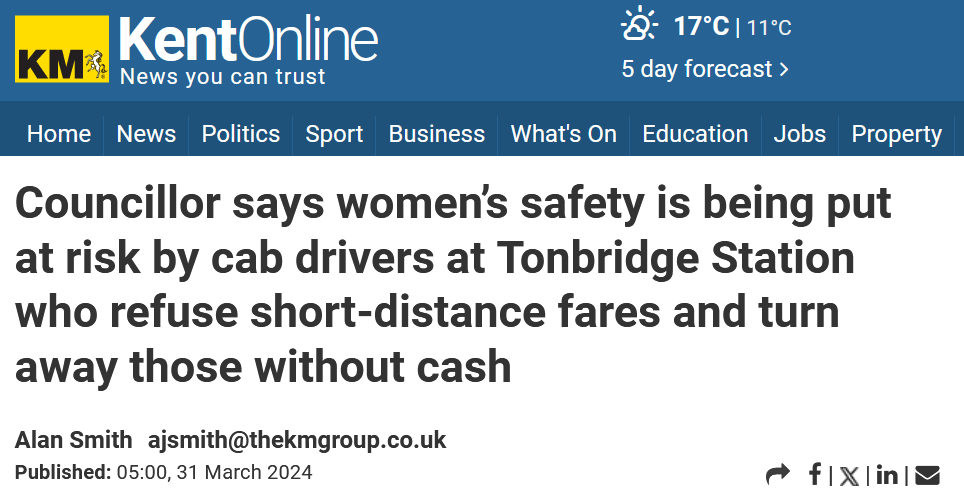
A few headlines from local news sites provide a flavour of this, and these concern either areas where the process is ongoing or, in the final piece below, where the process is complete and problems have arisen. The pros and cons and various arguments relating to mandating card payments needn’t be discussed here, but the graphics below are linked to the full articles if anyone feels the need for a flavour of some of the issues:
And so to Scotland, and the following piece appeared on the Glasgow Live website this week:
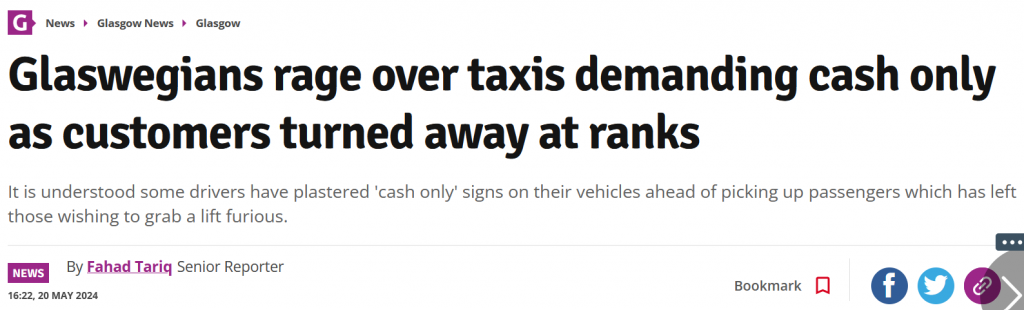
Which, in the context of the lengthy preamble above, should be pretty self-explanatory in terms of the issues involved. Also, what it’s important to point out in comparison to the other licensing authorities above is that Glasgow City Council hasn’t made the provision of card payment facilities mandatory for taxi drivers. Nor, as far as I’m aware, have any other of Scotland’s 30+ local authorities responsible for taxi licensing. (And, short of FOIing each council, or perhaps the Scottish Government, it’s possible that no-one at all in Scotland could say definitively how many, if any, local authorities have followed the lead of the likes of Transport for London or Cardiff City Council above.)
So to taxi users blaming taxi drivers, and other taxi drivers blaming the dinosaurs, ultimately it’s down to regulatory failure, because the arguments and issues are by now well rehearsed, and the whole thing could easily have been sorted out years ago (as was done nationally in the Republic of Ireland, to cite one obvious comparison to Scotland).
But as well as bureaucratic inertia, or whatever the problem is, one clue might be found in a consultant’s report on the fare-setting process in Edinburgh, which was reported as saying (more than 15 months ago, for what it’s worth):
“It unclear whether the Council legally has the power to require the acceptance of card payments as a condition of licence and if committee decides to consider such a condition, then a full consultation process would be required prior to doing so, and also evidence for the need to impose such a condition.”
Quite what the legal impediment might be is anyone’s guess, but if that genuinely is a hurdle then it would apply to the whole of Scotland. But both England’s and Scotland’s local authority licensing powers derive from different framework legislation, so it would be interesting to know why England’s can, but Scotland’s can’t…
However, in any case, it would be easy enough for the Scottish Parliament to follow the Republic of Ireland’s example, but maybe best not to stray too far into the murky world of politics here.
In the meantime, however, as the latest Glasgow Live piece outlines, about half of the city’s black taxis are attached to the despatch operation Glasgow Taxis Limited (GTL) which offers card payment facilities. The other half can effectively do their own thing as regards card payments, for the reasons stated above. And, because this latter half rely primarily on on-street hires rather than the pre-booked hires undertaken by GTL, if you secure a taxi on the street then it’s probably more likely than the average not to offer card payment facilities.
Another thing is that it’s probable at least some GTL vehicles will be a bit more selective as regards offering card payments if hired on the streets rather than pre-booked – the Glasgow Live article implies that only non-GTL taxis will be sole traders, whereas in reality all taxi drivers in Glasgow will be sole traders. To that extent, GTL’s reach may not extend to compelling drivers to accept card payments for street hires, as opposed to those pre-booked through GTL.