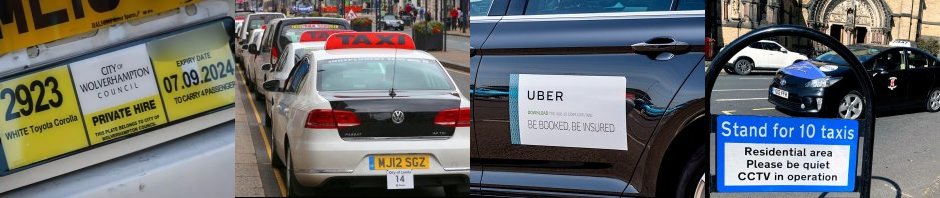
(A tentative first post on my shiny new blog, using an old WordPress theme. Go easy on me, I’m just practising…)
It looks like Uber has firmed up its promise (or threat…) to start operating in Aberdeen. According to the Press and Journal, Matthew Freckelton, Uber’s UK head of cities, told a local chamber of commerce podcast that the ‘US taxi app giant’ may be granted a licence in June, and could ‘go live as early as August’.
Much more on that in subsequent pieces on here but, as an opener, a few comments on particular aspects of today’s P&J article.
First, while not wanting to sound too anoraky, as is eminently predictable in articles like this the terminology is a tad incorrect and misleading. In particular, in the main Uber isn’t a ‘taxi’ firm. In the UK at least, it uses private hire cars (PHCs) and drivers, not taxis. Of course, the term taxi is often used generically to include private hire vehicles, particularly in press reporting and in everyday speech. But since many of the issues involved are quite technical and involve strictly delineated legal concepts (say), then it’s maybe not too pedantic to point this out.
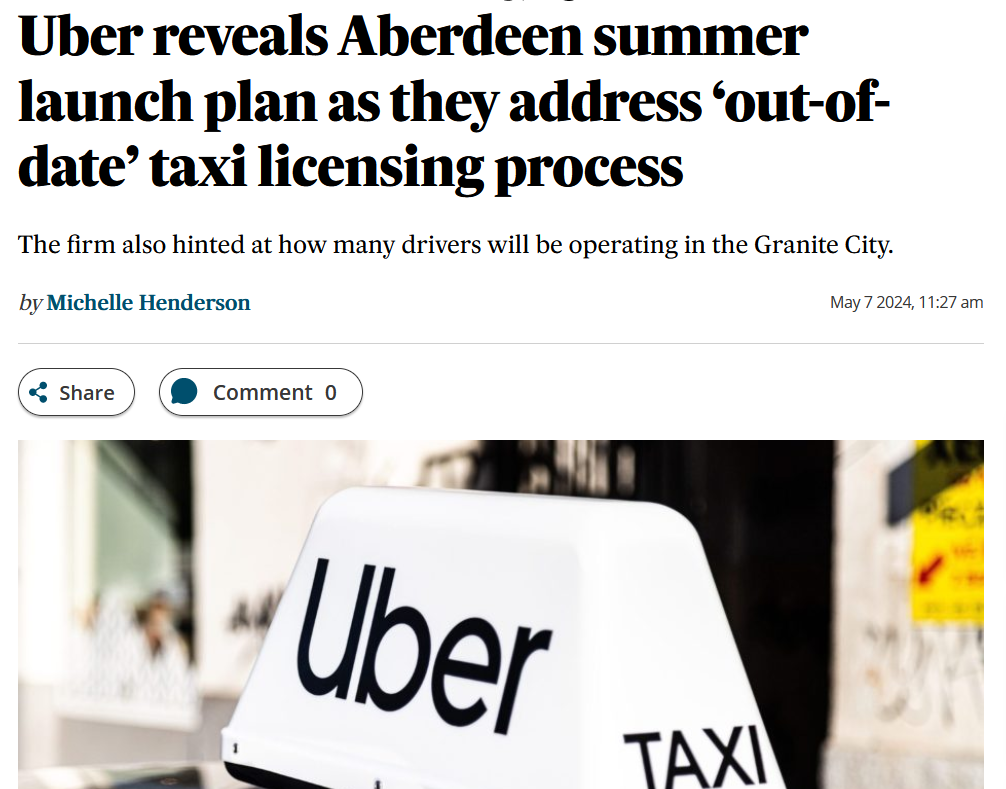
And look, for example, at the stock image used by the P&J to illustrate the piece. I’m not sure if any of Scotland’s 30+ licensing authorities would allow the rooflight in the photo on a PHC. And, indeed, the word ‘taxi’ is specifically prohibited from being displayed on a PHC by the legislation which applies across Scotland. Again, these issues may seem unnecessarily legalistic (or whatever) but such matters are of considerable import in the trade. And, as these contrasting examples from Bedford and Northampton in England demonstrate, things like the display or otherwise of such signage is hotly disputed, and can have important legal and safety implications in that they can facilitate illegal hirings, thus potentially endangering passengers and drivers.
(To be fair, at least the article doesn’t use the misleading and meaningless ‘ride-hailing’ term to describe Uber, a description routinely used by many journalists – see below for letter sent to the press.)
But without actually listening to the podcast, a couple of points made in the P&J’s article are perhaps worthy of comment. Uber’s Matthew Freckelton says: “When we go live, we will be taking from the existing pool of drivers and we think drivers will want to come to us.”
To an extent that’s maybe just stating the obvious. On the other hand, it perhaps indicates why Uber’s presence in Aberdeen would be a chimera – more a case of rearranging the deckchairs, as opposed to fundamentally changing the ‘taxi’ landscape. But in turn this maybe indicates why Uber was initially reluctant to enter Aberdeen a few years ago. In England, Uber tends to rely on cheap migrant labour licensed by bottom-of-the-barrel local authorities, neither of which seem realistic options in Aberdeen – drivers in Scotland (whether taxi or private hire) cannot habitually work in any area other than the one they’re licensed in. In England, once they are licensed drivers can work anywhere, subject to certain rules.
But these matters are fundamental to Uber’s business model, and also to the extent to which Uber would make a substantial difference in Aberdeen (or, for the same reasons, Dundee). And while the stiff new driver licensing requirements which will represent a barrier to Uber in Aberdeen are ultimately up to the local council and councillors, the likelihood of the Scottish Parliament liberalising the cross-border working rules north of the border seems remote, in the short-term at least.
An obvious error in the P&J’s article seems to be this:
If approved, locals and tourists visiting Aberdeen would be able to request an Uber to travel around the city and to destinations in Aberdeenshire.
However, it’s unlikely the firm could accept bookings from Aberdeenshire to Aberdeen without the need for a special license.
Correct me if I’m wrong, but the direction of travel doesn’t matter with regard to crossing local authority boundaries. A driver licensed by Aberdeen City Council could travel to the Moray Council, Fife Council, or City of Edinburgh Council (say) areas with passengers, or drive there to bring them back, provided the trip either starts or finishes in the Aberdeen City area.
However, a driver licensed by Fife Council (say) can’t habitually work in the Aberdeen City area, or vice versa. Unlike, of course, how Uber operates south of the border under the licensing regime there.
Anyway, apart from that the article is predictably full of the usual Uber boilerplate PR/comms stuff, but this maybe stands out for sheer chutzpah: “Matthew hopes by introducing the scheme, they can inject millions into the economy while helping to keep Aberdonians moving.”
Eh? Either Uber simply rearranges the local industry deckchairs, in which case any profits would presumably end up back in Wall Street rather than with Aberdeen’s presumably more locally-owned traditional firms. Or, if Uber has its way, it’ll mean cheap labour supplanting local drivers, or at least fundamentally undermining the latter’s earning capacity, not to mention exacerbating the ‘gig economy’ dimension to the job. All of which would, of course, suit ‘taxi’ users and certain business interests in Aberdeen, not to mention Uber itself.
But which would hardly be consistent with ‘injecting millions into the economy’ (£18 million, to be precise!), never mind the wider political narrative about a ‘fairer’ Scotland, or whatever similarly vacuous bromide our new first minister could well be regurgitating, literally as I type. But we’ll see.
Edit: The P&J’s cross-border error seems to come from an article on the Aberdeen & Grampian Chamber of Commerce website accompanying the podcast. No point in going through it all with a fine tooth comb at this stage, but a couple of points are perhaps worth noting. First, this passage seems to conflate or confuse taxi and private hire drivers, and conveys the impression that they are perhaps one and the same, and that the terms are synonymous:
One issue that has presented itself in Aberdeen and throughout the country post-pandemic is difficulties in attracting private hire drivers.
The city boasted 849 taxi drivers in 2020, prior to lockdown. By the end of 2022, that had fallen to barely 605.
To be fair, to a degree there is a crossover, because a taxi driver’s badge in Scotland entitles the licence holder to drive either a taxi or PHC. And because Aberdeen’s entry criteria is the same for both taxi and PHC badges, in effect there is no point in issuing the latter. So according to the Scottish Transport Statistics (table 1.4), in 2022 there were 1,055 taxi driver licences in Aberdeen City. It’s unlikely that anyone will actually know precisely how many of these licence holders are actually driving taxis or PHCs, because the 1,055 can drive either. (However, precise taxi and PHC vehicle numbers are disclosed in the stats, and could be used as a proxy, but for present purposes there would be little point in pursuing that avenue.)
But the chamber of commerce’s figures are surely wrong, both before and after lockdown. An article on the Aberdeen Live website from December 2022 states a current figure of 1,080, as compared to 1,280 in 2019. This seems consistent with evidence from other towns and cities. However, the same table 1.4 from the 2019 Scottish Transport Statistics states a taxi vehicle number of 843, dropping to 593 in 2022. This seems consistent with the numbers cited by the chamber of commerce, thus the chamber’s figures are presumably for taxi vehicles rather than drivers. On the other hand, PH vehicle numbers have actually increased from 212 to 225 over the same lockdown-encompassing period.
Both the magnitude of the taxi vehicle fall, and the fact that PH vehicle numbers have increased at all over that period seem surprising (and there is probably some corollary between the two), but no real point in trying to rationalise that here. But as regards overall industry supply in the city, the taxi driver badge figures stated by Aberdeen Live are probably more compelling, and are consistent with those in the Scottish Transport Statistics (1,281 in 2019; 1,055 in 2022). Thus a fall in supply of c. 16-18 per cent, as opposed to the near 29 per cent posited by the chamber of commerce.
As regards the cross-border thing, it may be that the chamber has misconstrued what Uber’s Matthew Freckelton said during this section of the podcast. Or that what Mr Freckelton said was a tad misleading. But (and correct me if I’m wrong), there’s surely nothing to stop Rainbow Taxis (say) sending a car to Aberdeenshire, Dundee or Fife to collect a hire destined for the Aberdeen City Council area. Why Mr Freckleton states that Uber wouldn’t be able to do likewise is unclear, but it may relate to their policy of not taking advance bookings (and how that might not be commensurate with the Glasgow Airport (which is in Renfrewshire Council area, while Uber’s PHCs will be licensed by Glasgow City Council) pick-up scenario mentioned at around 10.45 on the video).
However, it’s not clear why that means that someone in Stonehaven couldn’t order an Uber vacant in Aberdeen to come out and drop them back in Aberdeen, or that they couldn’t order an Uber car en route to Stonehaven and secure its services back to Aberdeen. Both those scenarios are commonplace in the industry throughout Scotland, so perhaps the answer is simply that such transactions do not fit Uber’s business model rather than representing a licensing restriction. As regards the Glasgow Airport scenario, Mr Freckleton seems to be saying that it wouldn’t be done, rather than couldn’t. Another possible angle in this regard is that there’s maybe less of a coercive relationship between Uber and its drivers in that it can’t ordinarily compel drivers to undertake runs they may not want to do, which is generally less of an issue with the more traditional industry (and which, in turn, may be linked to the vexed question of employment status in both the taxi and private hire sectors).
NOTES
(1) For several reasons Uber may be more likely than elsewhere to use taxi vehicles in Aberdeen in addition to PHCs, but the business model used in the rest of the UK (including Edinburgh and Glasgow) seems to rely wholly, or at least predominantly, on PHCs.
(2) For what it’s worth, a few months ago the following was sent as letters to both the Courier in Dundee and the P&J. Being stuck in deepest Fife at the time, and not being an online subscriber, I’m not even sure if they were even published. But here they are anyway, and they cover the likes of the ‘ride-hailing’ terminology, not to mention more about the cross-border dimension in England, fare-setting and the disputed ‘knowledge’ tests.
Uber and Aberdeen
Fears that global ‘taxi’ brand Uber might be afforded ‘special treatment’ in Aberdeen seem misconceived.
One significant dimension to this seems to be that the rules on cross-border working might be relaxed. However, this is built into the ‘framework’ Scottish legislation, and isn’t really up to local council licensing authorities. Holyrood has examined the relevant legislation at least twice since the parliament’s inception in 1999, but clearly hasn’t thought to reframe the ban on cross-border working.
So, most obviously, while taxis and private hire vehicles (PHVs) can clearly cross council boundaries with passengers, they can only habitually work in the local authority area they’re licensed in. Therefore, for example, Uber couldn’t license drivers in a local authority area with lesser ‘entry barriers’ to circumvent the likes of Aberdeen City’s stringent topographical or ‘knowledge’ test.
To that extent, in terms of ‘taxi’ availability, Uber coming to Aberdeen might be more a case of rearranging the driver deckchairs within the existing pool rather than fundamentally increasing supply.
But which would benefit those who can afford to pay Uber’s ‘surge-prices’ charged at times of peak supply and demand mismatch, but might actually lead to longer waiting times for those who can’t or won’t pay the significantly higher fares, which indeed often smack of profiteering or price-gouging.
By contrast, south of the border Uber and other operators take advantage of the fact that PHVs can work anywhere in England, assuming the appropriate licenses are in place. Thus almost 40,000 PHVs are licensed by Wolverhampton City Council, but the vast majority work elsewhere, allowing drivers to circumvent local rules such as in-car CCTV requirements, vehicle age rules and local topographical tests. Wolverhampton Council describes itself as the ‘licensing authority of choice’, which is facilitated by a network of vehicle testing stations hundreds of miles apart, from Middlesbrough to Southampton.
Which is turn has led to local complaints about the likes of enforcement and related safety issues, not to mention unfair competition for local operators who take the more conventional route of being licensed by their own councils.
But which can’t happen in Scotland, and this may in part explain why Uber abandoned its original bid to come to Aberdeen.
And the likelihood of Holyrood amending the legislation in the near future to accommodate cross-border working generally, and Uber in particular, seems remote. In fact, and ironically, as I recall it one of the changes made to the legislation in recent years was to specifically enable councils to impose knowledge tests on PHV drivers – previously, this was only possible with regard to taxi drivers.
Therefore ‘special treatment’ for Uber seems unlikely, in the short term at least. Of course, Aberdeen City Council could significantly water down entry barriers and quality control, which would obviously favour Uber’s business model. But this would apply across the industry in Aberdeen, and to that extent might also find favour with other more traditional despatch operations. But which clearly wouldn’t be popular with incumbent grassroots drivers, for obvious reasons.
NOTES
1 I put the word ‘taxi’ above in inverted commas in places, because the word tends to be used generically in everyday use, while strictly speaking taxis and private hire cars are distinct legal entities. In the main, Uber almost always uses private hire cars, but there’s nothing in principle to stop them using taxis, which in fact they have done in the likes of Lewes District Council, which was used to circumvent the stricter private hire licensing rules in nearby Brighton and Hove.
Moreover, *taxi* tariffs are generally regulated in terms of *maximum* fares, thus that wouldn’t normally fit with Uber’s surge-pricing model, which is market-driven rather than set by a regulatory body. (A further possible barrier to Uber in Aberdeen is that, as I understand it, PHVs tend to have meters fitted, and then they effectively become taxis in terms of tariff regulation under the Scottish legislation, which is different to the position in England, where PHV fares are generally unregulated. On the other hand, I’m not sure if PHVs in Aberdeen are actually compelled to fit meters, or whether it’s more of an option, but I suspect that’s one of the issues Uber might have discussed with the council.)
2 There are hundreds of online press and other sources easily available regarding the Wolverhampton Council licensing situation in England.
This 2023 piece on the Manchester Evening News website is a reasonable summary of the position, though, and gives a good idea of the numbers involved. However, I doubt if *anyone* can actually state how many drivers licensed by Wolverhampton are actually working elsewhere. The article uses the driver’s home address as a kind of proxy, but which can’t be wholly accurate, but is probably reasonable enough as ball park figures – for example, if cross-border working was allowed in Scotland, a driver living in the Aberdeenshire Council area might be working in Aberdeen City, or vice versa. However, equating where drivers live with where they are working as drivers probably represents a fair approximation.
https://www.manchestereveningnews.co.uk/news/greater-manchester-cant-guarantee-high-27870814
Wolverhampton City Council’s map of approved vehicle testing stations also provides some kind of overview of the reach of their operation:
https://www.wolverhampton.gov.uk/licences/taxi-licences/approved-mot-testing-station
3 The knowledge test for private hire drivers thing (which Uber no doubt regards as an awkward regulatory barrier) has an interesting history – section 13(5) in the online legislation below indicates that the private hire dimension was added by the Air Weapons and Licensing (Scotland) Act 2015 (sic!). As I recall it, Aberdeen City Council had long had a knowledge test for private hire drivers, but this was challenged in the courts by a law student (and wannabee driver [who’s long ago moved on, I’d guess…]) as being ultra vires the legislation. Hence, I suspect, the subsequent inclusion of the 2015 amendment to explicitly enable knowledge tests for private hire drivers.
https://www.legislation.gov.uk/ukpga/1982/45/section/13
Uber and Dundee
As befits a brand like Uber, there’s a considerable amount of froth surrounding the possibility the ‘taxi’ firm will come to Dundee. That’s maybe unsurprising for a global behemoth built to a large extent on marketing, PR and ‘expert’ constructs like the ‘gig’ and ‘sharing’ economies, and meaningless terms like ‘ride hailing’ – in reality, these are just neoligisms for describing the decades-old structure and dynamics of the taxi trade.
So apart from a global brand and pushing the booking and despatch technology envelope, the reality is that Uber has hardly reinvented the taxi industry wheel. Where Uber has perhaps made a difference, in the UK context at least, it’s surely based on cheap, migrant labour licensed by local authorities with bottom of the barrel approaches to quality control.
For example, Wolverhampton City Council licenses tens of thousands of private hire drivers working in the likes of Blackpool and Southampton hundreds of miles away. That’s not possible under the Scottish legislation, so unless Dundee City Council lowers entry barriers (removing the electric vehicle requirement for new licences, for example) Uber would simply be a case of rearranging the deckchairs within the existing driver pool.
Of course, some will tell you that it’s always possible to hire an Uber on demand, even when more traditional taxis are unavailable. However, this is based on substantially hiking prices at peak times to match supply and demand, so fares could easily double, or in fact be set substantially higher.
This would certainly benefit the better off, but actually make waiting times longer for those who can’t afford to (literally) pay the price. Neither is it clear whether this modus would fit with Dundee’s regulatory model of taxis and private hire cars both fitted with meters and set at the council’s regulated maximum tariffs.
NOTES:
1. I’ve never read any definition of the ‘gig economy’ or ‘sharing economy’ that couldn’t be equally applied to the Dundee taxi trade, which I worked in for a couple of years in the late-1990s. Ditto what I know about the industry elsewhere.
Similarly, the term ‘ride-hailing’ is probably one of the most common used in relation to Uber, and this seems an attempt to differentiate it from the traditional trade. However, the Collins Dictionary defines ‘hail’ in this context as essentially synonymous with ‘flagging down’, thus in the context of an app booking ‘hail’ is simply meaningless, and indeed misleading. Morever, flagging down, or public hire (technically speaking) is strictly forbidden for Uber’s vehicles, which are almost always what are termed ‘private hire’ vehicles in the context of UK law.
A BBC News/LDRS article at the weekend about Uber applying for a licence in Hull uses the description ‘ride-hailing’, but also states that Uber is a ‘taxi’ firm. It then mentions a couple of local private hire firms which accept app bookings, implying that Uber is a different beast. However, if Uber was genuinely a taxi-only firm then it wouldn’t in fact need a licence to accept bookings in England, because south of the border there is no third-tier licence required for taxi-only despatch entities (only drivers and vehicles require licences). And in fact Uber is for licensing purposes essentially identical to the two private hire operations mentioned towards the end of the piece, as opposed to the inaccurate ‘taxi’ description and meaningless ‘ride-hailing’ term used earlier in this short article:
https://www.bbc.co.uk/news/uk-england-humber-68253983
2. Cross-border working by private hire vehicles in England is increasingly common and quite a high profile political issue, at least by the standard of these things. Essentially, drivers can licence in an area with lower standards and cheaper, more efficient licensing processes, but work elsewhere. This can save drivers hundreds of pounds annually in licensing fees, not to mention enabling them to circumvent stringent local rules such as in-car CCTV requirements, vehicle age rules and ‘knowledge’ tests for drivers.
Wolverhampton City Council is the most prominent licensing authority regarding this kind of approach, and the article below last year in the Manchester press said that Wolverhampton licenses c. 36,000 private hire cars, thus well in excess of 30,000 will be working elsewhere, from the likes of Southampton in the south to Blackpool and Middlesbrough in the north. I wouldn’t be surprised if most of these are drivers working for Uber, but in any case Uber’s total no doubt dwarfs the smaller local and regional players taking advantage of cross-border working. However, this practice is not possible in Scotland – taxis and private hire vehicles can travel across local authority borders, of course, but cannot habitually work outwith the council area they are licensed in.
https://www.manchestereveningnews.co.uk/news/greater-manchester-cant-guarantee-high-27870814
3. As far as I’m aware, private hire cars in Dundee (and Aberdeen) normally have meters fitted, which makes sense because both cities have an effective hybrid taxi and private hire fleet, working side-by-side from the same despatch operations. (Most UK cities have a more binary industry of distinct taxi and private hire sectors – London, most obviously, where today’s private hire vehicles are traditionally and informally known as minicabs). Under the Scottish legislation, if a private hire car has a meter fitted, then to that extent its fares are regulated in the same way as taxis. To that extent, if Uber cars in Dundee were required to fit meters, this would preclude their surge-price model. In England, private hire cars tend not to use meters, and even where they do, the fares are not regulated in terms of representing an upper limit.