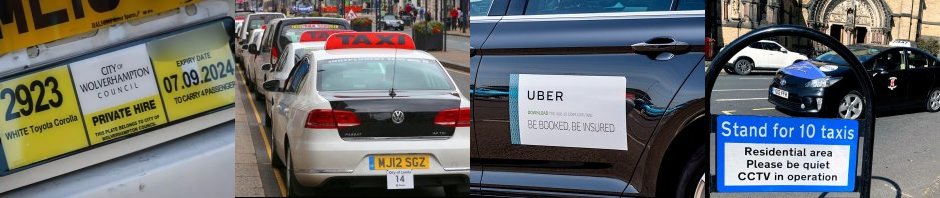
Press reports about the industry can often be confusing because of the incorrect use of terminology. And very often ‘expert’ input and analysis can be anything but. A recent article in Wolverhampton’s Express & Star illustrates both points. The online article was headlined thus:

Leaving aside the pointlessness of the strapline, the headline itself is simply incorrect. As the article subsequently makes clear, Wolverhampton is only the ‘taxi’ capital if private hire vehicles (PHVs) are included in the numbers. Wolverhampton certainly issues a huge amount of PHV licences, but its actual taxi numbers are unremarkable. So the headline is only accurate if the word ‘taxi’ in the headline is used in the informal sense to mean either an actual taxi (sometimes called a hackney carriage) or PHV.
Which is all very well to a degree, but since the article subsequently uses the word ‘taxi’ in its stricter sense, the looser usage in the headline seems a bit odd.
The article is based on a study by vehicle insurer Zego, which compared taxi and PHV numbers to population in each licensing authority, with the figures portrayed as vehicle numbers per 100,000 population. But which are largely meaningless, because Wolverhampton City Council in particular acts as a kind of PHV licensing version of the online activities of Amazon, Argos or Curries. So the ‘taxi’ figures per population are about as useful as using the number of washing machines despatched by a central Curries distribution centre and comparing them to elsewhere in the country, and concluding therefrom that households in the distribution centre’s area are much more likely than elsewhere to have a washing machine. Or, indeed, that each household may have several washing machines!
To be fair, it’s not clear whether Zego’s analysis outlined why its numbers were flawed in that way, because there’s no sign of the study online. Also, the Express & Star does allude that the numbers may be meaningless because it states that a huge number of Wolverhampton licensees actually reside in the Manchester area, but that isn’t explored further. However, on a slightly different tack, the article quotes Zego as saying:
“The difference between private hire vehicles and taxis is often misunderstood however, with many people assuming that the two terms are interchangeable.
“In reality, private hire vehicles are pre-booked through a licensed operator or ride-hailing app, such as Uber or Bolt, with fares agreed in advance. Taxis on the other hand typically use metered pricing set by the local council and can be flagged down by the customer.”
Thanks for the lecture, but the above also feeds a misunderstanding insofar as the implication is that Uber and Bolt are not licensed private hire operators. In reality, all private hire vehicles, including Uber’s and Bolt’s, are ‘pre-booked through a licensed operator’. Perhaps a more accurate portrayal would be to say that Uber and Bolt are licensed operators with app-only bookings. Other private hire operators may not use apps at all, although an operator of any size will these days normally use a mixture of app and traditional telephone bookings. But a private hire operator is a private hire operator, irrespective of the method of booking.
However, the main reason for my sarcasm is on a slightly different point – trying to find the actual study, and not really knowing much about Zego, I had a look on their website, and found this:
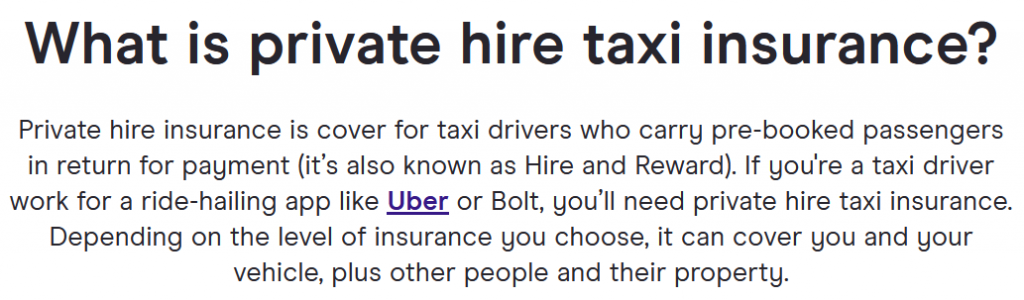
Oh, so according to Zego earlier: “The difference between private hire vehicles and taxis is often misunderstood however, with many people assuming that the two terms are interchangeable.”
So, instead, let’s jumble the two terms up to create a legally illiterate term in the title. Then there are two separate incorrect references to ‘taxi’ drivers. To put the tin lid on it all, there’s the expert’s and journalist’s favourite ‘ride-hailing app’ description, which will be examined in more detail on here soon. (Oh, the suspense…)
All that’s not to doubt that Zego’s insurance practices and policies aren’t legally and technically watertight (there are basically two types of hire and reward insurance – public hire, which only taxis can do, and private hire), but is it any wonder the public and press often find these things ‘Confusing’?
NB To ‘Confuse’ things further, in Scotland an ‘operator’ is either a taxi or private hire vehicle licence holder, or proprietor. Or a plateholder, in reference to the plastic plate usually affixed to a licensed vehicle, and representing the license.
The Scottish equivalent to a private hire operator in England is a booking office licence. But which in England doesn’t apply to taxis, while in Scotland a booking office licence is required for both taxi and private hire despatch businesses.
Thus both licensing regimes consist of three tiers – driver licences (badges), vehicle licences (plates), and operator licences in England and booking office licenses in Scotland for despatch operations. But, to reiterate, in England the third-tier despatch licence applies only to private hire, and not taxis.