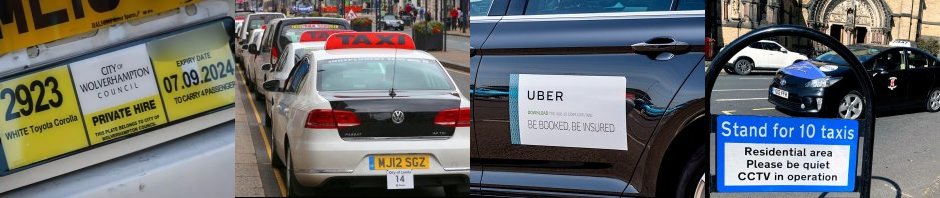
Another couple of days, and another couple of local articles on the Uber/cross-border/Wolverhampton stuff, or whatever. And with the usual jumble of inconsistent of misleading terminology, such as taxi/private hire/hackney carriage/ride-hailing, blah, blah.
For which the local press shouldn’t necessarily be blamed, because there’s also the same old, same old ill-informed, exaggerated and misleading claims by ‘industry leaders’, and the PR/’comms’ boilerplate from licensing councillors and council officials, rather than maybe a simple statement of facts.
First to Colchester, where Uber’s expansion is apparently ‘worrying’ local taxi drivers. Wholly unsurprising, just like corner shops and convenience stores would be worried if a Tesco Extra landed in their neighbourhood.
But the chair of the local licensing committee says:
“I get a lot of the licensing trade contact me and they’re worried about their businesses and whether it’s a level playing field. There’s lots of questions coming in about Uber.”
“I am expressing concern to make sure there is a level playing field across all private taxis, hackney carriages, and Ubers,” he said.
“I want to make sure no-one is disadvantaged.”
Which is about as useful as saying he’d like to ensure a level playing field between Tesco and the corner shops, therefore pretty much pointless. And rather than making it sound like Uber is something different in terms of licensing (for a start, there’s no such thing as a ‘private taxi’ – presumably he means a private hire vehicle, which by definition isn’t a taxi/hackney carriage), he should be aware that Uber are very probably doing nothing wrong in strictly legal terms, and that they’re actually licensed as private hire vehicles and drivers.
He’s then quoted as saying:
“I would start asking questions if my daughter was coming home late at night and I didn’t know who that driver was.
“I only want the people I love to be coming home in the safest ways possible.”
But which is again just touchy-feely waffle, essentially. And maybe makes it sound like he knows every one of the 600 or so drivers licensed by Colchester Council, while he wouldn’t know the driver whose photo and name will be on the Uber app, along with the various safety and tracking features, etc etc.
The article also says: “The councillor has written to the authority’s licensing team to ask for more information about Uber’s operation in the city.” [Emphasis added!]
That is from the local politician in charge of it all – ‘licensing chief’, or whatever. And sounds a bit like the home secretary writing to Home Office officials asking whether murder is illegal. Or something like that – he should know the basics of how it all works by now, which should be self-evident to someone in his position. The press aren’t asking him for a detailed exposition of the legal minutiae, rather than the basic principles and practices of industry licensing.
And so to Worcester, where: “Taxi drivers are increasingly concerned about out-of-town Uber drivers working in Worcester, damaging the local trade as they call for better protection and a fairer system.”
Again, no point going through all that with a fine tooth comb, but a couple of more specific points are worthy of comment, while the whole thing more generally sounds like the usual stuff about local drivers being marched up to the top of the hill by those ‘industry leaders’ again, only to no doubt be marched back down at a later date, assuming they haven’t died on that hill in the meantime. And a bit of sabre-rattling about possible legal action (which will very probably never progress beyond the status of ‘possible’, unless they just want to line the pockets of lawyers), and non-specific stuff about ‘illegal’ and ‘fake’ drivers, which again probably represents little more than throwing lots of mud around and hoping some sticks. But, specifically:
In a letter to hackney carriage drivers, Arshad Hassan, Chairman Worcester Taxi Association, said: “We will be drafting and signing a petition to present to the council with the aim of requesting Uber to implement Geo-fencing in Worcester.
Uber’s geofencing was outlined in this post the other day. And which, in principle at least, is certainly a thing. But Uber’s geofencing areas seem to encompass dozens of local licensing authority areas and local markets (and any more concrete information would be gratefully received), thus the chances of Uber basically affording preferential treatment to one local trade in one particular town seems effectively c. 0%. Uber simply isn’t going to destroy its national business model and how it interacts with the regulatory environment just because the chair of the local taxi association intends presenting a petition to the council, unfortunately. Likewise, one local provider says:
“The only way to stop them is for the council to write a letter to Wolverhampton council that Wolverhampton plated cars only work in Wolverhampton just as Worcester taxis only work in Worcester.”
Similarly, for precise reasons known only to themselves, Wolverhampton City Council’s licensing function has built a quasi-commercial licensing empire encompassing around 30,000 vehicles, 40,000 drivers and 400 operator licenses. To think that these people will voluntarily wind all this down to more appropriate numbers for a city of Wolverhampton’s size (maybe averaging more in terms of hundreds over the three licensing categories) is at best wishful thinking, at worst cloud cuckoo land.
The bottom line is that, by and large, Uber are doing nothing illegal, and neither is Wolverhampton City Council. In particular, putting a stop to the cross-border working that’s the crux of all of this will require legislation by the Westminster Parliament. And anyone down there who’s particularly interested in this kind of stuff will be well aware of the issues.
Meanwhile, back in Scotland the numerous ‘industry leaders’ represented on an official Aberdeen City Council liaison and consultation group have reportedly submitted this in objection to the consideration of Uber’s imminent licence application:
“In all cities in the UK where Uber operates, their model of operation is to use unlicensed drivers and unlicensed vehicles.”
Which unalloyed nonsense is even less subtle than some of the stuff from Colchester and Worcester. But about as useful as claiming that former first minister Humza Yousaf and current prime minister Rishi Sunak are illegal immigrants – likely to fool the gullible and stir up the credulous. But for those close to the levers of power who need to be persuaded, more likely to make the accuser look either ill-informed or disingenuous.
And from the official perspective there’s the likes of this from Worcester:
A Worcester City Council spokesperson said: “The council recognise and understand the concerns being raised by the taxi trade in relation to UK ride hailing apps such as Uber, offering their services in Worcester and will upon receipt of any petition consider what options if any are available to the council under the existing legal framework governing the control of hackney carriage and private hire vehicles.” [Emphasis added]
A bit more subtle than the stuff from the likes of the ‘industry leaders’ in Aberdeen. But little more than fine words, which say a lot while at the same time saying very little, thus again symptomatic of PR/comms boilerplate. The operative words are surely ‘if any’, with the implication being that there are actually no ‘options available to the council under the existing legal framework’.
So why not just say that? A quick Google search finds a BBC News piece about Worcester from more than six months ago, and which actually outlines the facts of the Wolverhampton and cross-border scenarios quite well.
But no doubt it will soon be cross-border deja vu all over again…